




Mission and Pastoral Measure 2011

Contents |
[edit] Introduction
The Mission and Pastoral Measure (MPM) 2011 makes provision for the legal reorganisation of parishes and benefices, dioceses and the closure and re-use of consecrated church buildings that are no longer needed.
The MPM allows bishops to:
- Close a church building to regular public worship. This is managed through a Pastoral Church Buildings Scheme.
- Provide a new use for a church building that has been closed for regular public worship. This is managed either as part of the process of closure, or at a later stage, with a separate Pastoral (Church Buildings Disposal) Scheme.
- Provide for the appropriation and disposal of parts of churchyards. This is managed by a Pastoral Scheme.
The MPM is divided into two volumes. Volume 1 deals primarily with pastoral reorganisation while Volume 2 (Dealing with Consecrated Church Buildings) addresses issues around church buildings. Within Volume 2, chapters 12 to 24 cover sections of the MPM that relate to church buildings, including Part 4 (Procedure for making pastoral church building schemes) and Part 6 (Buildings closed for regular public worship).
[edit] MPM Volume 2 under review
In 2020, the Legislative Reform Committee was tasked by the Archbishops' Council to oversee a review of the MPM. The review was led by the Parish Reorganisation and Church Property Department. It was intended to allow the Church of England to develop a proposal for what an improved and simplified MPM could look like in the anticipation that detailed legislative proposals would follow.
In summer 2021, the Green Paper: Mission in Revision (GS 2222) was published. The Green Paper noted that the number of church buildings has been on the decline since 1941. The impact of the Second World War on the built environment led to serious consideration of how the disposal of church buildings could be managed and what uses would be suitable.
Since the 1990s, the closure rate of churches has remained at roughly 20 to 25 per annum. For the majority of closures, an alternative use was found.
Parts of the Green Paper explored specific options for change relating to the reuse of church buildings including:
- Omitting the requirement for Church Buildings Council (CBC) reports before church closure proposals.
- Providing for an interim or alternative status to churches being “open” or “closed”.
- Simplifying the requirements around the future use of closed churches and dealing with the disturbance of human remains.
At a July 2021 meeting of the General Synod, members approved the consultation paper for the review of the MPM. The initial consultation on the paper closed on 31 October 2021. An analysis of the responses was scheduled for 2022.
[edit] Related articles on Designing Buildings
- Annual conservation management statements.
- Archaeology and construction.
- Conservation area.
- Ecclesiastical exemption.
- Enterprise and Regulatory Reform Act 2013 and listed buildings.
- IHBC responds to Review of the Mission and Pastoral Measure 2011.
- Listed building consent order.
- Local listed building consent order.
- Planning authority duty to provide specialist conservation advice.
- Planning permission.
[edit] External resources
IHBC NewsBlog
IHBC sponsors Gardens Trust event 23-4 Sept 2026
.jpeg)
'Learning from the Past, Shaping the Future’ takes place in Milton Keynes
Renovations to Frank Lloyd Wright's Fallingwater complete
.jpg)
World Heritage Preserved project opens house for tours again
Shakespeare Birthplace Trust places Hall's Croft on HAR Register
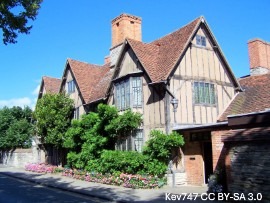
Stratford-upon-Avon home of Shakespeare's daughter is 'At Risk'
Lady Grange’s House repaired on St Kilda
.jpg)
National Trust for Scotland repairs stone cleit with link to famous island resident
Griff Rhys Jones on BBC Radio 4 Today programme
,_Green_Lane,_Derby.jpg)
The Victorian Society’s President unveiled its latest Top Ten Endangered Buildings 2026.
Need a MATE? Book your place now.
IHBC offers free webinars on applying for IHBC accreditation (Full & Associate).
UK Stained Glass Repository finds windows new homes
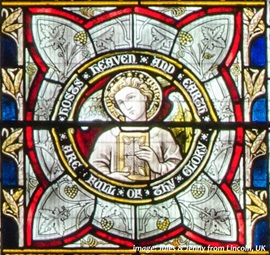
How are stained glass windows are rescued, stored and repurposed?
APPGEBE report sets high aims for quality
'Government must not sacrifice quality in drive to build 1.5m homes'
New measures protect Historic Shipwrecks from heritage crime

Underwater cultural heritage benefits from new HE guidance
How could the City of London skyline look in 6 years' time?

Visualisation shows approved planning applications as completed buildings
National Trust for Scotland calls for VAT cuts
Heritage neglect is encouraged by current policies
IHBC's 'Context' Issue 186 features Industrial Heritage
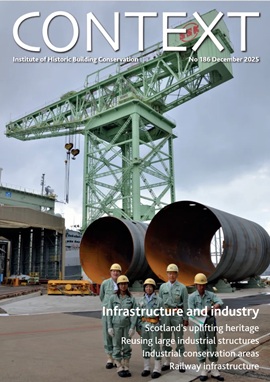
IHBC's members' journal reports on the challenges of conserving infrastructure
Book now for IHBC Annual School 2026
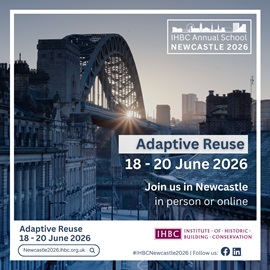
IHBC Annual School is taking place 18-20 June 2026 in Newcastle
RICHeS Research Infrastructure offers ‘Full Access Fund Call’
RICHeS offers a ‘Help’ webinar on 11 March
Latest IHBC Issue of Context features Roofing
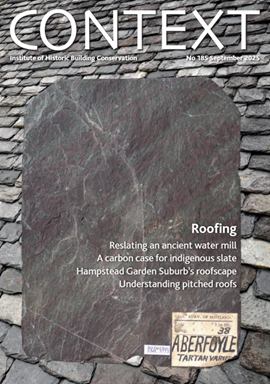
Articles range from slate to pitched roofs, and carbon impact to solar generation to roofscapes
Three reasons not to demolish Edinburgh’s Argyle House

Should 'Edinburgh's ugliest building' be saved?
IHBC’s 2025 Parliamentary Briefing...from Crafts in Crisis to Rubbish Retrofit
IHBC launches research-led ‘5 Commitments to Help Heritage Skills in Conservation’
How RDSAP 10.2 impacts EPC assessments in traditional buildings

Energy performance certificates (EPCs) tell us how energy efficient our buildings are, but the way these certificates are generated has changed.